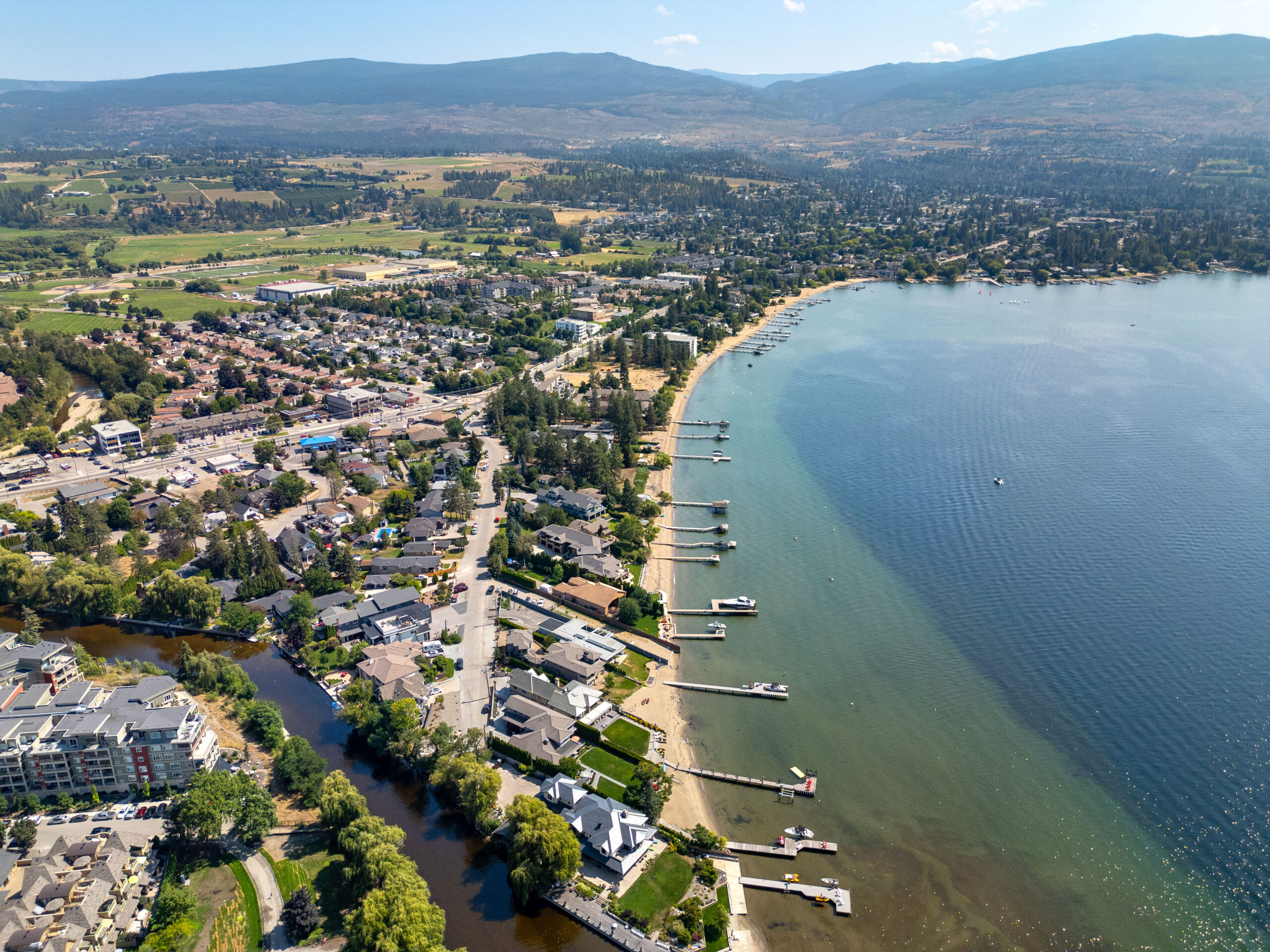
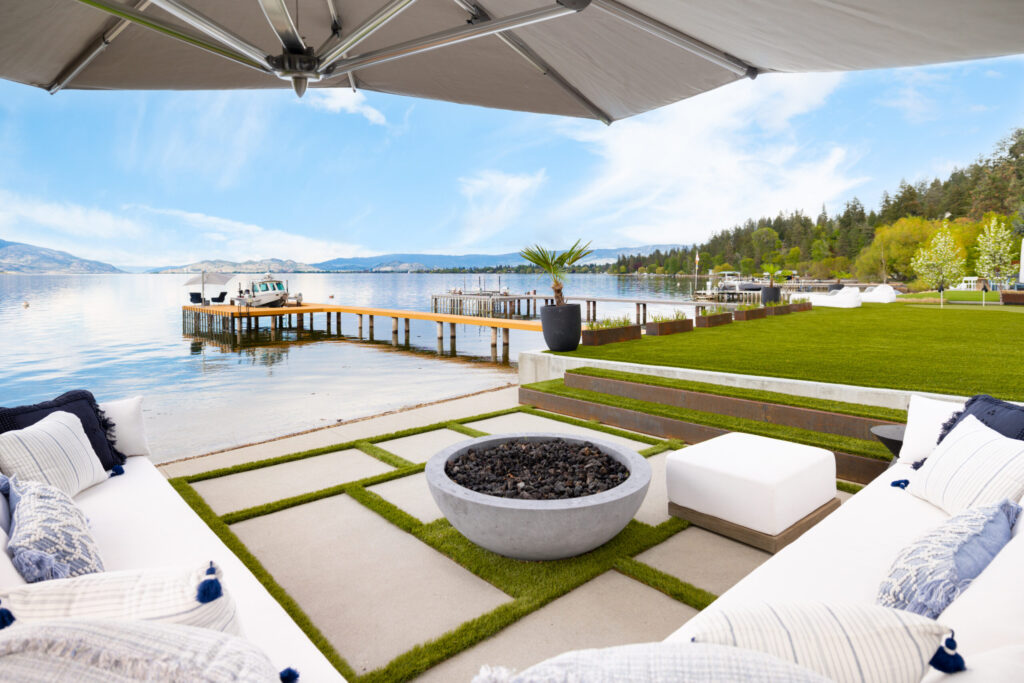
Buying lakefront property on Okanagan Lake is different from buying any other home in Kelowna. The house matters, but what you can do with the water in front of it is set by shoreline rules most buyers have never heard of, and those rules decide whether you can have a dock, a fence, or even a beach of your own. Lakefront also trades differently from the rest of the market, with fewer sales, longer marketing times and a wider gap between asking and selling prices.
Here are the six things to check before you make an offer on the lake, and what the latest numbers say about price.
- The foreshore zone in front of the property
- Whether the dock permit will transfer to you
- Whether you actually own the beach
- Where the high-water mark and the build line sit
- High bank or low bank, and what each means for how you live
- Flood risk, lake levels and insurance
The provincial rules below apply all around Okanagan Lake. Local rules differ by jurisdiction: this guide uses the City of Kelowna’s, and West Kelowna, Lake Country, Peachland, the Regional District and Westbank First Nation lands each set their own.
Why lakefront is its own market
Lakefront is a small market. From January to September 2026, 41 single-family lakefront homes sold across the Central Okanagan, about five a month, compared with 1,473 single-family homes overall. Buyers take their time, and sellers who price against an old peak wait longer. The table below shows the latest figures for the segment.
| Single-family lakefront | September 2026 | September 2025 | 2026 to date | 2025 to date |
|---|---|---|---|---|
| Sales | 2 | 7 | 41 | 52 |
| Median sale price | $4,025,000 | $2,100,000 | $2,039,000 | $1,472,500 |
| Average sale price | $4,025,000 | $2,797,571 | $2,593,848 | $1,945,674 |
| Days to sell | 141 | 102 | 91 | 93 |
| Sale price as a share of list price | 93.67% | 93.13% | 94.47% | 92.48% |
| New listings | 14 | 11 | 144 | 189 |
| Active listings (end of month) | 74 | 85 |
Read these numbers with care. With so few sales, the mix of homes that happen to sell drives the averages, so a big jump in the median or average from one year to the next usually reflects which homes sold rather than a change in values. The year-to-date columns are steadier. In 2026 to date, lakefront homes took 91 days to sell against 60 for single-family homes overall, and sold at 94.47% of list price against 96.53%. To see what is on the market today, browse the current lakefront homes for sale in Kelowna.
1. Check the foreshore zone first
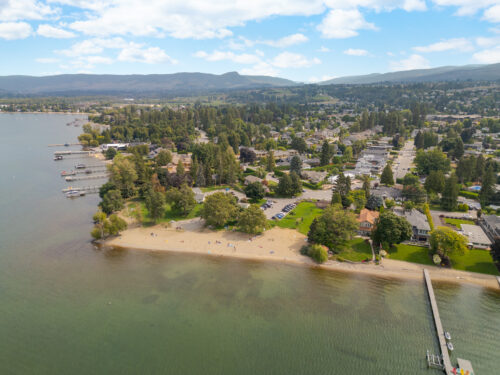
Below the high-water mark, the lakebed and foreshore in front of almost every Okanagan Lake home is provincial Crown land, and any work there needs provincial approval. To guide those approvals, the Province maps the shoreline of Okanagan Lake into four sensitivity zones under the Okanagan Large Lakes Foreshore Protocol. The zones protect habitat such as kokanee shore-spawning beds, freshwater mussels and rare foreshore plants.
- Black zone: critical habitat. The most sensitive stretches of shoreline. The Province says development in a black zone is likely inconsistent with its priorities and likely will not be approved.
- Red zone: high habitat value. Work may be possible, but expect a qualified environmental professional, more conditions and a longer process.
- Yellow zone: moderate habitat value. Fewer requirements than red, with conditions still attached.
- No colour zone: low or unknown habitat value. The lightest requirements, but permission is still needed for work below the high-water mark.
The zone also shapes timing. In-water work is restricted to windows set to avoid spawning and other sensitive periods, so even a fully approved dock repair can have to wait for its window. Your dock builder or environmental professional will confirm the dates that apply to your stretch of shoreline. Local governments can add their own, more detailed foreshore rules on top of the provincial mapping.
The practical step is simple: ask for the zone before you write an offer, and make your offer conditional on confirming what the zone allows for the plans you have in mind. If a dock is the reason you are buying, treat the zone as a deal term, not a detail.
2. Dock permits: find out whether yours will transfer
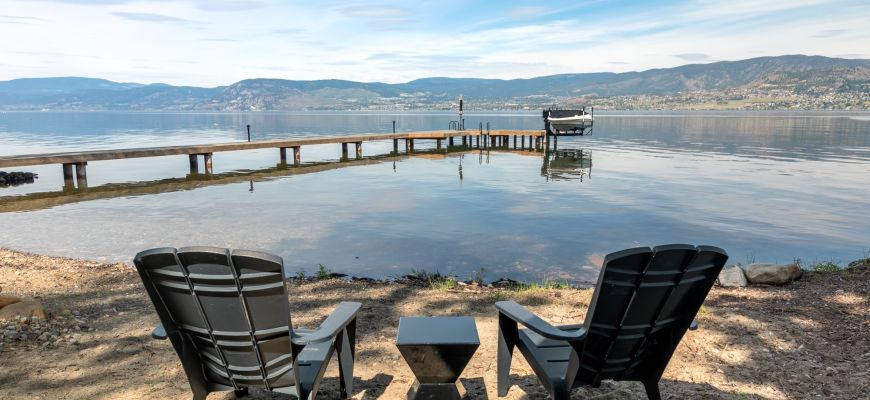
A dock on Okanagan Lake sits on Crown land, so it needs provincial authorization under the Land Act. There are two common forms, and the difference matters when a property changes hands (Province of BC, private moorage):
- General Permission. If a dock meets all the standard conditions for size, placement and design, it is deemed authorized with no application. When the property sells, nothing needs to be assigned: the new owner simply has to make sure the dock still meets the conditions.
- Specific Permission (or a lease). Required when a dock does not meet the standard conditions, when the site is in a designated application-only area, and for stand-alone boat lifts, boat ramps and permanent ways. On a sale, a Specific Permission has to be formally assigned through the same process as a moorage lease.
Before you remove conditions, find out which one applies. Ask the seller for the authorization, confirm with FrontCounter BC, and have your dock builder check the dock against the current conditions. Some older docks in the Thompson Okanagan region were built under earlier standards, and the rules allow for that, but only if the owner can prove when the dock was built or altered.
Only one dock is allowed per waterfront property. Under the General Permission, the only improvements allowed on a dock are those needed to moor a boat: pilings, anchor lines, non-overhead boat lifts and a walkway. Boathouses, roofs, sun decks and hot tubs are not permitted. Other rules can apply on top of the Province’s, including federal fisheries requirements and City of Kelowna bylaws, and in some areas First Nations are consulted.
The big important thing is you have to have permission to do anything on waterfront.
Shannon and Tamara Stone, Real Estate for Real People, March 7, 2022
Structures from an earlier era are the other trap. Covered boathouses, roofed boat lifts and decks built over the water still stand along the lake, and buyers often ask for one after a summer on the water. Assume anything like that will not be approved new, and ask how the existing structure is authorized before you pay for it.
3. Do you actually own the beach?
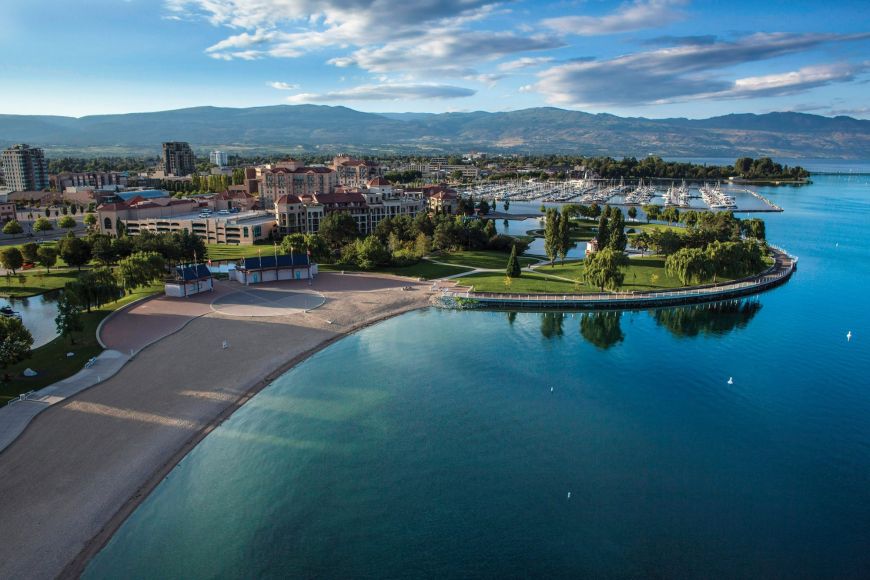
Not every home that looks lakefront owns the shoreline in front of it. On their podcast in 2022, Shannon and Tamara described properties near downtown, along Abbott Street, where the City had bought lakefront homes, subdivided the beach off as public land and resold the houses. From the street it still looks like waterfront, but the owner does not control the beach and cannot build a dock there. Check the title, a current survey and the City’s Official Community Plan before you assume the water’s edge is yours.
Even when you do own to the water, the foreshore itself is not private. In BC the Province owns nearly all freshwater foreshore, and the public keeps the right to pass along it. Docks must not block public access along the shore. On a quiet stretch of lake this rarely matters in practice, since most people stay near the public beaches, but it is worth knowing before you plan a fence or a gate to the water.
4. The high-water mark and the build line
Within the City of Kelowna, the City protects a strip of land along Okanagan Lake called the riparian management area. Under the 2040 Official Community Plan, it is 15 metres wide, measured from a high-water mark set at an elevation of 343.0 m (the highest target lake level plus half a metre for waves). A qualified professional can establish a site-specific high-water mark where the shoreline shows the standard line does not fit.
Inside that strip, changes to land or structures, from grading and landscaping to new building, generally need a Natural Environment Development Permit unless an exemption applies, and the City’s guidelines aim to keep the area natural. In practice, that affects where a pool, patio, retaining wall or fence can go. In one of their Abbott Street listings, the sisters noted, the owners owned right to the water and had a licensed dock, but could not run a pool fence into the protected area.
Many lakefront homes have walls, patios or structures that were built before today’s rules. Those often stay, but no agency will promise in writing that they always can. Treat anything close to the water as a question for your due diligence, not a given.
5. High bank or low bank
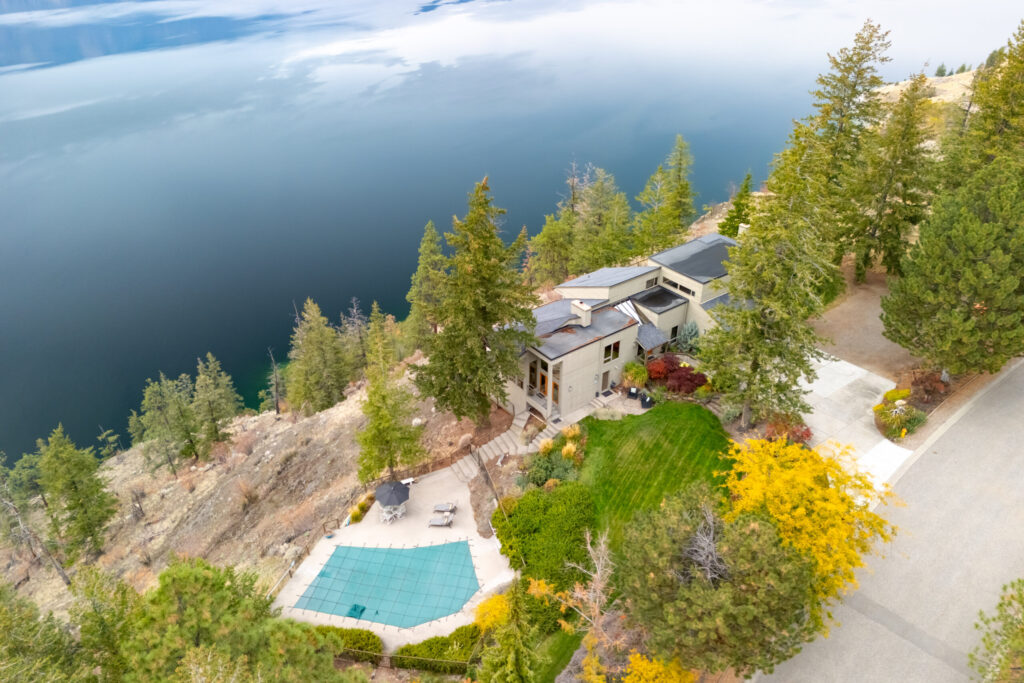
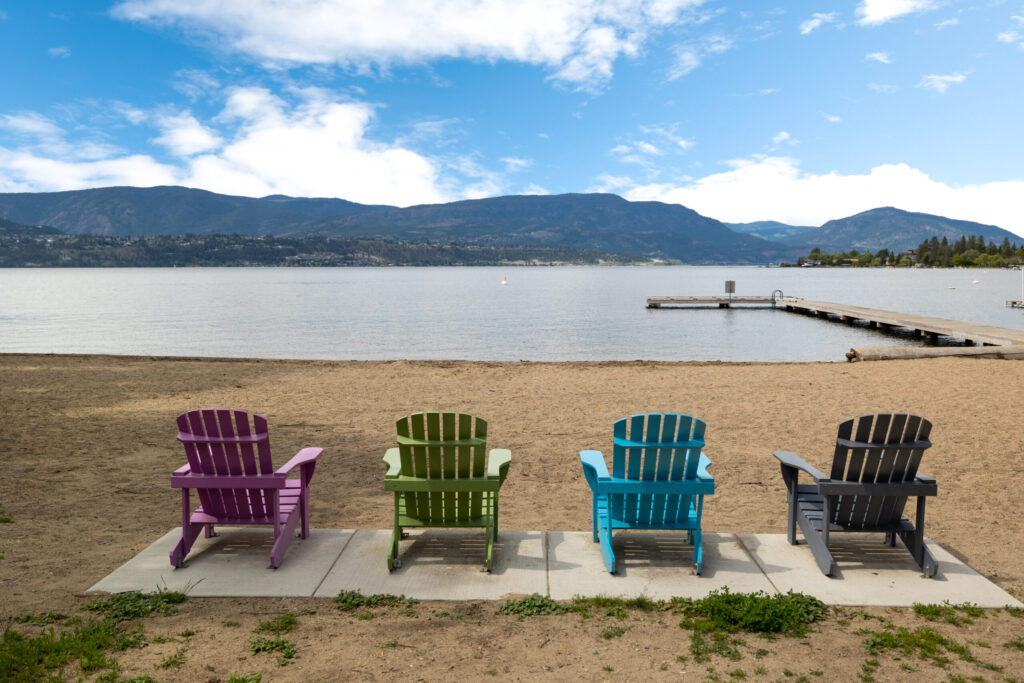
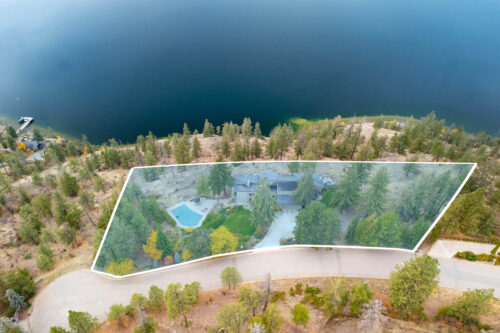
Not all lakefront is flat, easy access to the water. High-bank properties sit above the lake and usually trade easy access for views and privacy: you reach the water by stairs or a small tram, but no one on the beach is looking into your living room. Some of the most private estates on Okanagan Lake are high bank. Low-bank, or level lakeshore, lets you walk straight from the lawn to the water, which families with young children and people who swim or paddle every day tend to value most.
Buyers often ask how much more level lakeshore costs than high bank. There is no reliable rule. It depends on the stretch of lake, the lot and, most of all, on the buyer, which is why comparable sales on the same kind of bank are the only fair benchmark.
And if the view matters more to you than walking to the water, Kelowna lakeview homes give you the outlook without the foreshore rules, the dock permits or the flood exposure.
Some of the most spectacular estates are high bank because they don’t have anybody looking in their windows.
Shannon and Tamara Stone, Real Estate for Real People, March 7, 2022
6. Flood risk, lake levels and insurance
Okanagan Lake is a managed lake. The Province operates the Okanagan Lake Dam at Penticton and draws the lake down gradually through fall and winter, then sets spring levels based on snowpack and inflow forecasts. Forecasts are not guarantees. In spring 2017, record May inflows pushed the lake to 343.25 m on the provincial gauge, its highest level since the dam was built and well above the normal full level of 342.48 m (Province of BC 2017 flood review). Shoreline properties flooded, foreshore eroded, and docks and retaining walls were damaged around the valley.
Low water brings its own problems. In a low-snowpack year, some owners cannot lower their boats from their lifts, and docks can sit out of the water for the season. Ask how the dock performed in both high and low years.
Before you buy, check whether the home sits in the floodplain using the Okanagan Basin Water Board flood mapping and the City of Kelowna’s maps, and ask how the house compares with the flood construction level. Then talk to an insurer. Overland flood coverage varies by insurer and by property, and on their podcast the sisters described lakeshore homes that could get fire, theft and earthquake coverage but not flood coverage. Get a written quote before you remove conditions. High-bank homes generally carry far less flood exposure than level lakeshore.
Looking at a lakefront home? Talk to us before you write an offer. Tell us which property you are considering and we will go through these shoreline questions with you, so the view is not the only thing making the decision.
Talk to us about a lakefront homeWhy lakefront homes take longer to sell, and what a price cut means
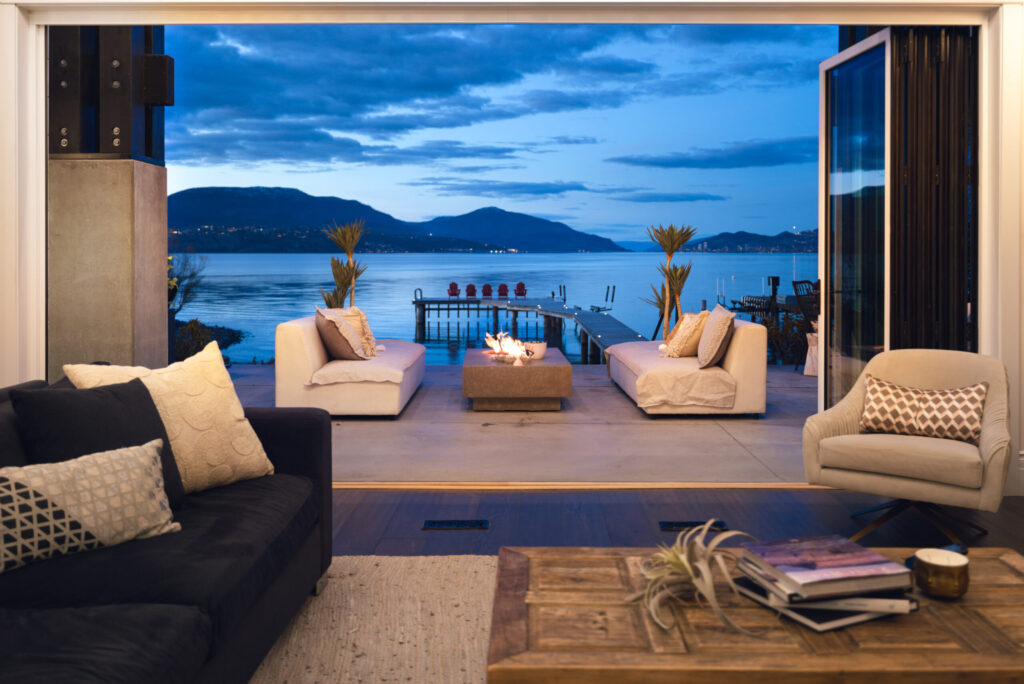
Lakefront buyers are few, well informed and rarely in a hurry. Many are choosing a way of life rather than reacting to interest rates, and they will wait for the right shoreline. That is why lakefront homes take longer to sell than the typical single-family home, and why the gap between asking and selling price is wider.
If you are selling, price against recent lakefront sales rather than the last peak, and have the answers ready before you list: the foreshore zone, how the dock is authorized, the survey showing the natural boundary, and the floodplain status. Unanswered shoreline questions can stall an offer, or keep one from arriving at all.
If you are buying, a price reduction after a long time on the market usually means the owner is catching up with the market, and it can be a real opening to negotiate. A reduction on a fresh listing deserves a closer look: sometimes it is simply a pricing correction, and sometimes it points to a shoreline or permit issue worth asking about before you fall for the view.
Selling on the lake? Talk to us about pricing your home against recent lakefront sales, and about the shoreline questions buyers will ask before they make an offer.
Talk to us about selling lakefrontBuying lakefront property: a checklist for your offer
Before you remove conditions on a lakefront purchase, make sure you have:
- Confirmed the foreshore zone and what it allows for the plans you have, such as a dock, a boat lift or shoreline work.
- Seen the dock authorization, and know whether it is a General Permission or a Specific Permission that needs to be assigned to you.
- Checked the title and a current survey for where your property ends, including any public land between the house and the water.
- Located the riparian management area and any walls, patios or structures inside it.
- Checked the floodplain mapping and received a written insurance quote that states whether overland flood is covered.
- Compared the price with recent lakefront sales on the same kind of bank, not with the last peak.
Frequently asked questions
Often, but it depends on the foreshore zone and provincial approval. Docks in black zones are unlikely to be approved, and every dock needs a Land Act authorization, either a General Permission or a Specific Permission. Only one dock is allowed per waterfront property.
A General Permission does not need to be assigned: the new owner is covered if the dock still meets its conditions. A Specific Permission must be formally assigned, so confirm which applies with the seller and FrontCounter BC before removing conditions.
The City protects a 15-metre riparian management area measured from a 343.0 m high-water mark. Construction, grading and landscaping inside it generally need a Natural Environment Development Permit. West Kelowna, Lake Country and Peachland set their own rules.
Yes. In BC the Province owns nearly all freshwater foreshore, and the public keeps the right to pass along it. Docks must not block public access along the shore.
It depends on the property and the insurer. Some level lakeshore homes in the floodplain have difficulty getting overland flood coverage, so get a written quote before you remove conditions.
There are few buyers at this level, they are well informed, and shoreline questions such as the zone, dock authorization and floodplain status take time to answer. Across the Central Okanagan, lakefront homes usually take longer to sell and sell further below list price than single-family homes overall; the table above has the latest figures.
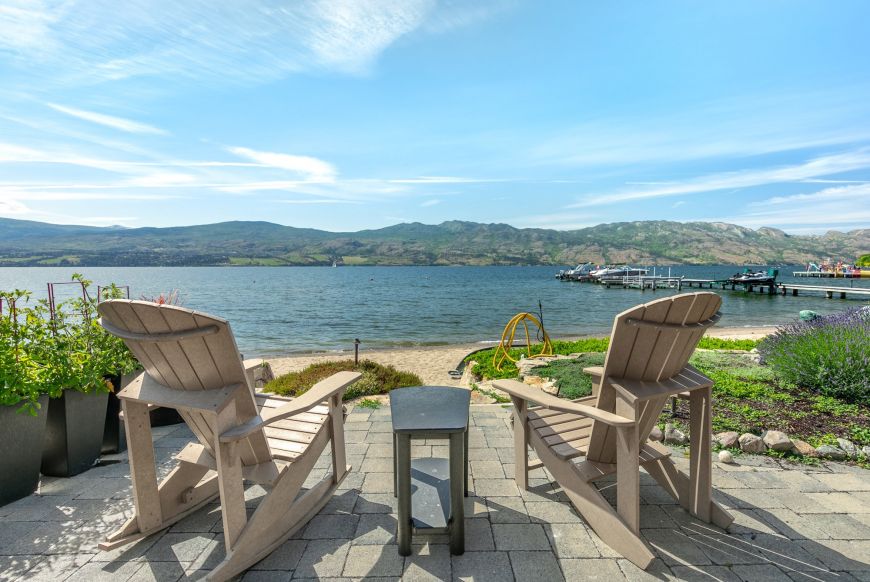
Lakefront is one of the most rewarding purchases in the Okanagan, and the one with the most fine print. Ask the shoreline questions early, get the answers in writing, and let the numbers, not the view alone, set your price. When you are ready to look, browse our Kelowna waterfront homes for sale, read about Kelowna’s luxury neighbourhoods and what makes a luxury home, and follow the wider Kelowna real estate market each month.
This guide is general information, current as of its last update, and not legal, environmental or insurance advice. Rules change and every shoreline is different: confirm the details for a specific property with FrontCounter BC, the local government and your lawyer before you remove conditions.